
Justice
The judiciary in the Czech Republic, as in other democracies and states under the rule of law, is defined by the Constitution so that courts pursue their duties as independent institutions.The system of ordinary courts is made up of District, Regional and High courts and the Supreme Court. The structure of the system of administrative courts copies the system of ordinary courts. Their competence and organisation are laid down by the Czech Constitution and other laws. The organisation and competence of public prosecutor offices are also prescribed in this manner. The chief public prosecutor is nominated by the Minister of Justice and appointed by the Government. Judges are appointed by the President of the Czech Republic. The Constitutional Court stands outside the system of ordinary courts.
Constitutional Court
The Constitutional Court is a judicial body protecting the Constitution. Its status and powers are enshrined directly in the Constitution of the Czech Republic. The Constitutional Court of the Czech Republic is seated in Brno.
The Constitutional Court is a specialised autonomous state authority that is independent of the system of ordinary courts. Its principal task is to protect rights under the Constitution, the Charter of Fundamental Rights and Freedoms and other constitutional laws of the Czech Republic. It also has other powers, such as decisions in certain matters concerning the right to vote and assessments of the compliance of international treaties with the Constitution during the ratification procedure.
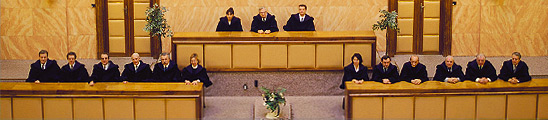
The Court comprises fifteen judges, who deliver rulings in three-member chambers or as a full court. Judges of the Constitutional Court are appointed by the President of the Republic for ten-year terms.
Judgments delivered by the Constitutional Court within its substantive scope are final and are not subject to any rights of appeal.
Last update: 16.8.2011 16:02


